Saturday, June 7, 2008

Einstein and Math

Einstein is well known for his work in physics, but what about math? Did he brought new ideas to mathematics, or was he influenced by mathematical ideas? Before answering these questions, lets look on a short summary of Einstein achievements - from Wikipedia:


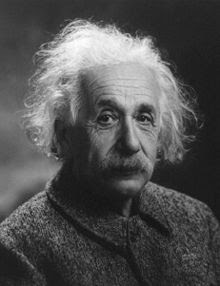
Albert Einstein was a German-born theoretical physicist. He is best known for his theory of relativity and specifically mass–energy equivalence, E = mc^2. Einstein received the 1921 Nobel Prize in Physics "for his services to Theoretical Physics, and especially for his discovery of the law of the photoelectric effect."

Einstein's many contributions to physics include his special theory of relativity, which reconciled mechanics with electromagnetism, and his general theory of relativity, which extended the principle of relativity to non-uniform motion, creating a new theory of gravitation. His other contributions include relativistic cosmology, capillary action, critical opalescence, classical problems of statistical mechanics and their application to quantum theory, an explanation of the Brownian movement of molecules, atomic transition probabilities, the quantum theory of a monatomic gas, thermal properties of light with low radiation density (which laid the foundation for the photon theory), a theory of radiation including stimulated emission, the conception of a unified field theory, and the geometrization of physics.


As you can see he contributed to a lot of different topics in physics. Math is mentioned nowhere in this short summary and for a good reason - he was after all a physicist. However to do anything in any of the fields mentioned above, a very good understanding of math is required.

In my opinion, Einstein relationship with math can be divided into two periods. The first period was in childhood when he first heard about mathematics:
Einstein was introduced to math when he was ten years old. In 1889, family friend Max Talmud, introduced him to mathematics, and philosophy texts, including Kant's Critique of Pure Reason and Euclid's Elements (Einstein called it the "holy little geometry book"). From Euclid, Einstein began to understand deductive reasoning, and by the age of twelve, he had learned Euclidean geometry. Soon thereafter he began to investigate calculus.
In 1895 Einstein tried to apply to Swiss Federal Institute of Technology in Zürich, Switzerland. He was required to pass an entrance exam which he failed - but he got exceptional marks in mathematics and physics. In 1896 he finally enrolled in the mathematics program at ETH. He graduated in 1900 from there with a degree in physics as a teacher of mathematics and physics.

His graduation marks the beginning of a second period - now he was no longer studying math. He was now looking on it as a tool to solve problems that he encountered. However math refused to be only a tool for him:
By mid 1901 he had a temporary job as a teacher, teaching mathematics at the Technical High School in Winterthur, and after this in a private school in Schaffhausen. These positions were all temporal - he had a desire to get to an university. It took a lot of time and effort but in 1912, after publishing a lot of groundbreaking articles (in physics), Einstein returned to Switzerland to accept a professorship at the ETH. There he met mathematician Marcel Grossmann who introduced him to Riemannian geometry, and at the recommendation of Italian mathematician Tullio Levi-Civita, Einstein began exploring the usefulness of general covariance (essentially the use of tensors) for his gravitational theory. Ultimately, the ideas and approaches of Riemann geometry provided him what he needed to develop his general relativity theory - the distortion of space-time under the influence of gravity. While it is usually thought that physics "push" mathematics in this particular moment it was mathematics that contributed to advance of physics.


The above is only a short summary - it is possible to say more, but the answers to the questions I started with are already obvious: While there are no evidence to suggest that Einstein had any direct influence on the development of math, he and his ideas were greatly effected by it. On the other hand, as it is always with physics, his theories put forward new problems that required development of new mathematical methods to be solved.

Quotes about math by Einstein:
"God does not care about our mathematical difficulties. He integrates empirically."

"Do not worry about your difficulties in Mathematics. I can assure you mine are still greater."

"As far as the laws of mathematics refer to reality, they are not certain, as far as they are certain, they do not refer to reality."

"Yes, we have to divide up our time like that, between our politics and our equations. But to me our equations are far more important, for politics are only a matter of present concern. A mathematical equation stands forever."

"Pure mathematics is, in its way, the poetry of logical ideas."

"How can it be that mathematics, being after all a product of human thought which is independent of experience, is so admirably appropriate to the objects of reality?"

"One reason why mathematics enjoys special esteem, above all other sciences, is that its laws are absolutely certain and indisputable, while those of other sciences are to some extent debatable and in constant danger of being overthrown by newly discovered facts."

Friday, June 6, 2008

Two amazing videos

I just stumbled on two excellent videos. The first one is about the Briggs-Rauscher oscillating reaction:
From Wikipedia: "The Briggs-Rauscher oscillating reaction is one of a small number of known oscillating chemical reactions. It is especially well suited for demonstration purposes because of its visually striking color changes: the freshly prepared colorless solution slowly turns an amber color, suddenly changing to a very dark blue. This slowly fades to colorless and the process repeats, about ten times in the most popular formulation, before ending as a dark blue liquid smelling strongly of iodine."

You can watch the video on GoogleVideo or on StumbleUpon Video.

The second video is a complete movie - Life after people. If you ever wondered how the world will look like if the human race will just disappear in a second, don't miss this movie. You can watch it on GoogleVideo. It also includes a lot of scenes of collapsing buildings...

The Eiffel tower - in what was the center of Paris...

I wanted to watch this one for a long time,. and I glad I finally did. It documents the effect of time and the ability of nature to adapt extremely well, in my opinion.

Thursday, June 5, 2008

Tips for using Compiz fusion on Ubuntu Hardy

This post is a simple how-to for adding extra plugins to Compiz, and for enabling some extra options and repositories. It would be best to read it to the end before trying to implement anything mentioned in it.

A side view of my desktop

Firstly we will need to install the following extra packages:

sudo aptitude install compizconfig-settings-manager compiz-fusion-plugins-extra compiz-fusion-plugins-main simple-ccsm

If you get an error about package not found download this Hardy repository list.
After this go to System->Preferences->Appearance->Visual Effects and click on Custom.
Optionally you can also install fusion-icon (sudo aptitude install fusion-icon) - it will allow you to control compiz from the taskbar.

The next step is to assign a different background to every side of you desktop cube. One way to do this is to use the wallpaper plugin. But it can be done without using a special plugin - you can do the same usig only the desktop cube plugin. To do this do the following: System->Preferences->Advanced Desktop Effects Settings->Desktop Cube->Appearance. You will see there an option to add background images. Add the images you want displayed (You will need one image for every side of the cube). Now press Alt+F2 and type gconf-editor. Go to apps->Nautilus->preferences and uncheck "show desktop". It is possible that you will need to log out for the changes to be activated.
You can also put any images you want on the top and bottom of the cube using the cubecups plugin.

There are a lot of plugins available in Ubuntu repositories. But the latest plugins are not there. To get them you will need to manually install them. To do this firstly get all the dependencies:

sudo aptitude install compiz-bcop compiz-dev build-essential libtool libglu1-mesa-dev libxss-dev git-core

Now type the following (make sure you are not root):
mkdir compiz
cd ~/compiz
git clone git://anongit.compiz-fusion.org/users/wodor/anaglyph
git clone git://anongit.compiz-fusion.org/fusion/plugins/atlantis
git clone git://anongit.compiz-fusion.org/users/metastability/atlantis2
git clone git://anongit.compiz-fusion.org/users/smspillaz/fireflies
git clone git://anongit.compiz-fusion.org/users/warlock/freewins
git clone git://anongit.compiz-fusion.org/users/b0le/photowheel
git clone git://anongit.compiz-fusion.org/users/pafy/screensaver
git clone git://anongit.compiz-fusion.org/fusion/plugins/snow
git clone git://anongit.compiz-fusion.org/users/metastability/snowglobe
git clone git://anongit.compiz-fusion.org/users/smspillaz/stars
git clone git://anongit.compiz-fusion.org/fusion/plugins/tile
git clone git://anongit.compiz-fusion.org/fusion/plugins/wallpaper

Now you need to compile the plugins. To do this type:
cd compiz/atlantis2
make
make install

You will need to repeat it with all of the plugins. You can also download my script that will do all of the above. Just download it and make it executable. If you will decide to uninstall, cd to the directory and type make uninstall. You can also use checkinstall instead of make install - this will produce a .deb file. Also, note that the latest version of cubeaddon plugin is not on the list - for it to work you need to install the latest Compiz version.

If you want even more plugins, you can use the Compiz SVN repository to get the latest version of all plugins and Compiz. Generally installing anything from a SVN repository is not recommended. Do this on your own risk. To do it add the repository:

deb http://download.tuxfamily.org/shames/debian-sid/desktopfx/unstable/ ./

And the GPG key:

wget http://download.tuxfamily.org/shames/A42A6CF5.gpg -O- | apt-key add -

Type:
sudo aptitude update
sudo aptitude install compiz-fusion-all


This should install the latest version of Compiz. If the install fails with a message that your libpango library is too old download and install these: libpango-common libpango libpango-dev
The order in which you install them is important - they can only be installed in correct order. Also, if you will decide to remove them from your system be warned - I nearly broke Ubuntu when I tried to remove them. By using anything in this post you agree that I am in no way responsible for any damage it may cause to your computer.

Wednesday, June 4, 2008

Too much time on the Internet

Apparently I spend too much time on the net...


I recently did a personality "test" that is suppose to tell you what is your file extension. According to it I am a .pdf:

You are .pdf  No matter where you go you look the same.  You are an acrobat.  Nothing is more important to you than the printed word.
Which File Extension are You?


To some degree this result is accurate. I do value the printed word...

Also have you ever wondered what it is like to jump into a 7,964 mile deep hole? watch the following video for a short introduction to this idea:


This is a clear "don't do this at home" video.

I also had a very interesting conversation with Beans on his post Mathematical Beauty and Tea. It ended with talks about doing a math horror cartoon for his presentation at school.

Firefox RC1 - A short review

I am using FF3 RC1 for some time, and while it works well most of the time I cannot say I like it. My main problem with it is that it crashes every time I try to download an image. It seriously influence my photoblog. Another problem is that most of the extensions I use are not compatible with it, so I have to force install them. You can read about how to do this in my post Firefox extensions.

A RC2 will be released today (It will take a few days before it will be available for Ubuntu) - I hope it will be more stable. It is really annoying when every time you try to download an image FF crashes...

Tuesday, June 3, 2008

Web Apps for the student?

I just stumbled on this post - Must Have Web Apps for the Hi-Tech College Student. I must say I am totally confused. The post begins with a claim that "There are tons of new web apps that have been created with the college student in mind." I suppose it is so, but it is hard to believe that some of the apps mentioned in the post were created for students. For example Netvibes. I don't use it, so I don't know much about it. But when I visited it I didn't notice anything that would suggest that it was created for students. Meebo is another example. While it is useful for communication, it is even better for wasting time. If someone did it especially for students he clearly did them a bad thing.

The other apps mentioned also don't look like especially useful for a student. Google Docs is a nice application, but unless you tend to write your homework in groups (and for some reason prefer to do it while sitting at different computers) , I see no reason to use it instead of OpenOffice.
The online calculators mentioned can be replaced by your own calculator and by Google calculator for unit conversion. If you are using Gnome-do you can even do conversions without visiting Google.

Perhaps I am seeing it this way because I am a math student and the only program that I find useful for me as a student is Latex...
What do you think about it? Are those lists about apps for students just an attempt to get some traffic or do they offer any solid advice?

Monday, June 2, 2008

A summer place

Our world is a unique place... even if there are millions of other planets with intelligent lifeforms on them, the planet we live on is still unique - because any other place will be different. We have a lot of conflicts and difficulties but there is also rest and beauty of nature. The video below was made by my friend CRISSANCA67. For me the important part in it is the images - I never liked music and I don't listen to it. The images however manage to tell an interesting story - they manage to capture a lot of unique moments.


In other news I clearly managed to find myself a lot of problems. I decided to study History of Mathematics this semester, hoping that it will be an easy and simple course. Unfortunately, it turned out that I am supposed to do a lot of extra reading for the course. I have to read the whole History of Mathematics by Boyer. Normally this wouldn't be a problem, but it is a 700 pages book and I have to read it in the library. The book is well written, and it is interesting to read - if you happen to take a course in this subject it is a good choice. It begins with what is known about mathematics in ancient Egypt, then jumps to Mesopotamia and Greece. I thought about buying it, but it would mean ordering it from Amazon or eBay, which even with its relatively cheap price I don't want to do. I managed to get a copy of History of Mathematics by David M. Burton, but since the exam will be based on Boyer there is not much reason to read Burton. Hopefully I will manage to read Boyer enough each week. I read it for only about an hour last week because I had to go to a restaurant with some friends of mine, whom I didn't see for a long time... It seems that I will have more time this week. I should probably try to read half of it by the end of next week.